Awdah AI builds map-free augmented-reality navigation that records a route as it's walked and guides a disoriented person back along it — no pre-built maps, no installed infrastructure, working entirely on-device and offline.
A few snapshots of the map-free AR return-navigation experience.
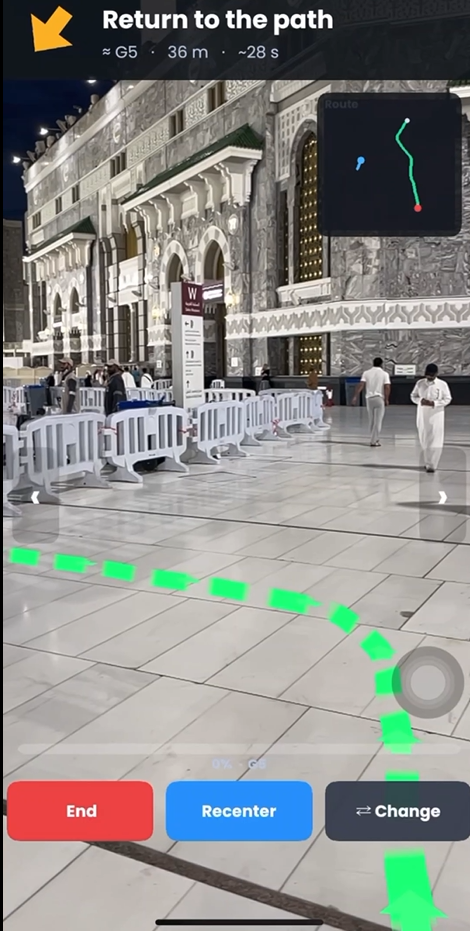
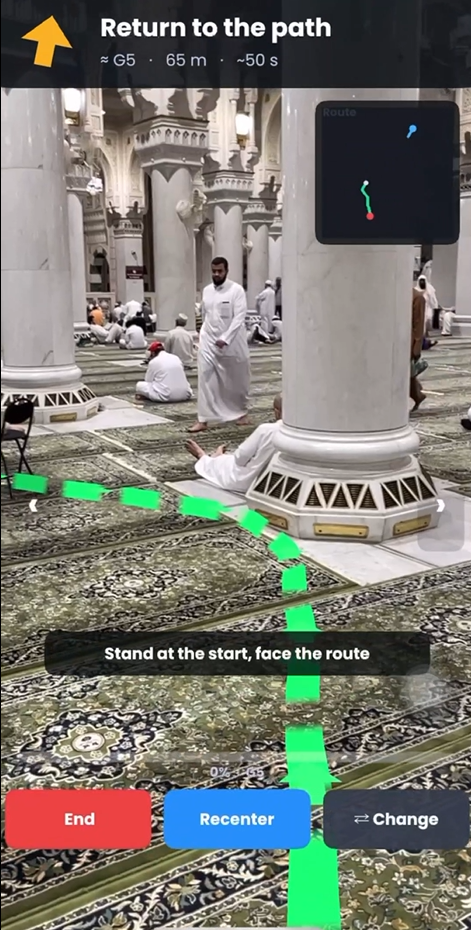
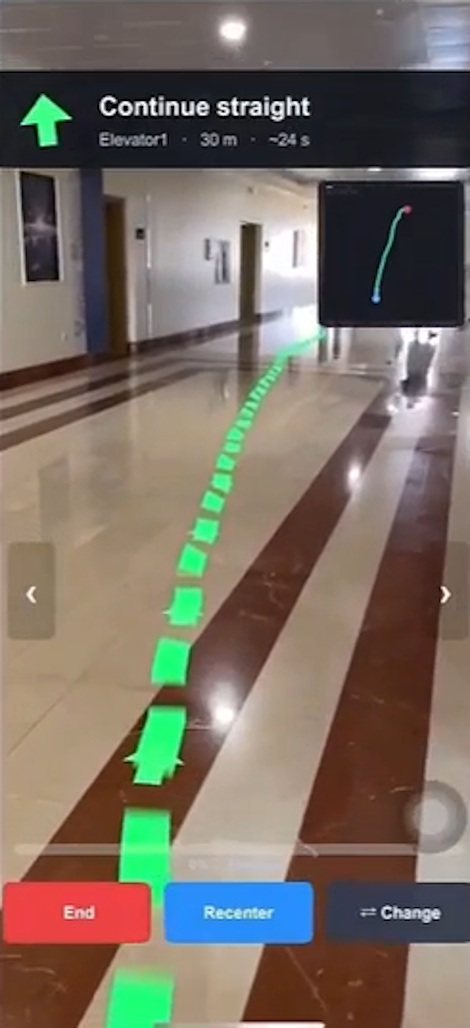
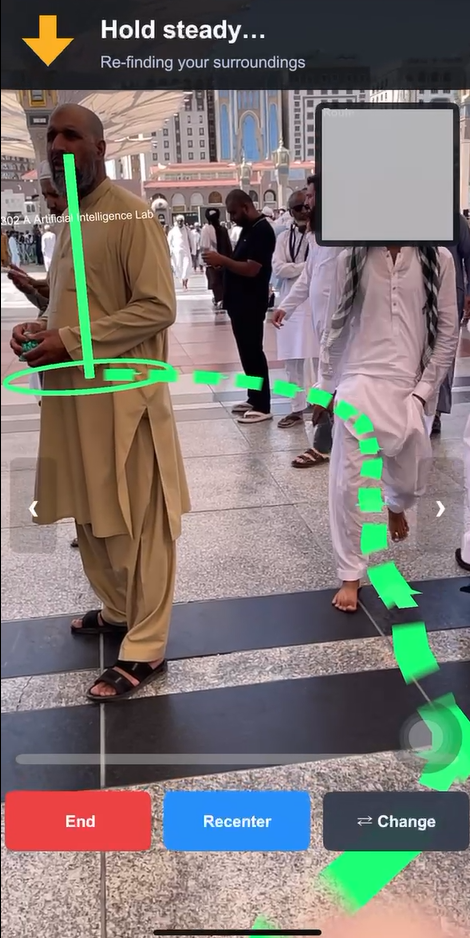
A short introduction to Awdah AI — the problem, the idea, and what it feels like to be guided back to where you started.
In crowd-dense venues, satellite positioning is corrupted by multipath, abstract maps overwhelm vulnerable users, and every existing tool stops at "where are they" — never "how do they get home."
In crowds of millions, elderly, first-time, and neurodiverse visitors lose their group in moments — with no signage or stable address to fall back on.
A frightened, disoriented person with autism, dementia, or a young child can't read a map or pick a destination from a list.
Dense crowds and tall structures create heavy multipath bursts — raw GPS fixes can drift 15–55 m off the true path, sometimes mislocating the very origin a user must reach.
Existing trackers locate a lost person for a caregiver. None of them reconstruct an egocentric route home for the subject. That last mile is ours.
The route is authored simply by walking it once. Everything after that — reconstruction, detection, and guidance — happens automatically on-device.
Walk the route once. The app records position fixes on the phone as you go — outdoors via GPS, indoors via visual-inertial tracking.
Confidence-Weighted Trajectory Reconstruction scores every fix and fuses them through a robust Kalman smoother, gating multipath outliers.
A confidence-gated disorientation detector senses separation, wandering, a geofence breach, or a caregiver / panic trigger.
The reconstructed route is reversed and rendered as profile-adaptive AR cues — footprints, arrows, or panels — leading the user home.
A real recording of the deployed iOS prototype: a route is trained by walking it once, then re-navigated using floor-registered AR cues with no satellite signal and no pre-built map.
The hard problem isn't reversing a recorded path — it's obtaining a reliable path in the first place. CWTR scores every position fix on reported accuracy, kinematic plausibility, and timing, then fuses fixes through a robust Kalman smoother that down-weights and gates multipath outliers before any reversal happens.
Use cases: campus / large-venue navigation, return-journey wayfinding.
Use cases: child safety, autism / dementia wandering, pet recovery.
The Adaptive Reverse-Trajectory Recovery Engine — runs continuously in the background.
A χ²-innovation-gated Kalman filter — the standard robust-filtering recipe — can lock onto a displaced track once a plausible-looking multipath burst slips past its gate. CWTR's kinematic-plausibility factor scores each fix against pedestrian dynamics independently of the filter state, so a contaminated state can never corrupt the gate. In a 55-trace field campaign around the Haram district of Al-Madinah, this held trajectory jitter to 0.8° versus 1.6° for the same χ²-gated baseline — and on severely degraded traces, the system flags the reconstruction as unreliable rather than rendering a fictitious route.
The same reconstructed route is rendered differently depending on who's following it — a real-time, on-device optimization that balances symbolic load, screen density, and contrast against each user's cognitive-assistance profile.
From the dense crowds of the Haram district to hospitals, campuses, and family safety — the same map-free engine adapts to the venue and the user.
Reuniting pilgrims separated in the crowds of Makkah and Madinah, where satellite reception is heavily degraded by multipath and signage is limited. Validated with a 55-trace field campaign around the Prophet's Mosque.
Map-free wayfinding and return navigation in large, complex venues with zero installed infrastructure.
Helping patients and visitors retrace their way through unfamiliar buildings without relying on signage.
Designed for neurodiverse users and at-risk wanderers, with cueing calibrated to lower cognitive and sensory load.
A parent follows AR arrows straight to a separated child in a crowd-dense venue — no app install required to find them.
The same two-device tracker/finder mode applies to recovering a wandering pet via its logged GPS path.
When a tracked subject exits a safety perimeter around the origin, the system reacts automatically — without waiting for a panic button.
The device crosses the geofenced safety perimeter around the stored origin.
The cloud relay creates a temporary, scoped hyperlink — no persistent account access.
The link is sent via SMS or instant message to a designated caregiver device.
Opening the link launches the zero-install browser app and renders a live route to the subject.
Geofenced safety perimeter — breach triggers an automatic, temporary caregiver link.
Every claim on this page traces back to a reproducible, seeded evaluation — simulation, recorded GPS traces, and an on-device field study.
Returning a disoriented person to a safe origin is an everyday need for people with autism or dementia, young children, and visitors lost in crowd-dense venues. We present a self-trained, map-free AR navigation system that records a route as it is walked and later guides the user back along it — without a pre-built map and without installed infrastructure. Confidence-Weighted Trajectory Reconstruction (CWTR) scores every position fix and fuses fixes through a confidence-driven robust Kalman smoother, reducing reconstruction error by up to 78% over raw fixes in heavy-multipath simulation while flagging unusable traces as unreliable rather than emitting a fictitious route.
| Method | RMSE (m) | Jitter (°) |
|---|---|---|
| Raw GPS fixes | 17.46 ± 2.36 | 115.3 |
| Fixed-gain Kalman / RTS | 4.47 ± 0.81 | 3.6 |
| χ²-gated adaptive KF | 7.15 ± 9.29 | 2.3 |
| CWTR (proposed) | 3.76 ± 2.10 | 1.3 |
Heavy-multipath operating point, M = 120 Monte Carlo trials. CWTR vs. fixed-gain Kalman: −15.9% RMSE (Wilcoxon p = 9.7×10⁻⁹).
55 walked traces, 6,347 GPS fixes, recorded around the Haram district. CWTR eliminated all kinematically impossible segments and cut jitter by up to 53% under moderate multipath.
A native Unity / AR Foundation (ARKit) realization achieves 15.8 cm mean end-point error across 21 runs — 100% within 1 m — entirely without satellite positioning.
A confidence-gated disorientation detector cuts false wandering triggers from 100% to ~8% on purposeful motion corrupted by GPS multipath, while preserving true detections.
Research and development engineer turned researcher with 18+ years of combined industry and academic experience. Currently a Research Assistant at the Dr. Hussein El-Sayyed Center for Scientific Research, University of Prince Mugrin, Al Madinah — leading work on safety-critical vehicle control, AI-based smart-city transportation, and adaptive XR systems.
Previously a Software Engineer at Advantest Corporation (Japan, 2006–2018), and later founded and led Inventus Limited (2018–2024). Sole inventor on two U.S. patent applications, including the adaptive reverse-trajectory recovery system behind Awdah AI.
Whether it's pilgrims in Madinah, visitors in a crowd-dense venue, or a family member who wandered off — we'd like to talk about your use case.
Get in touch